Interview mit Jamie Kastner
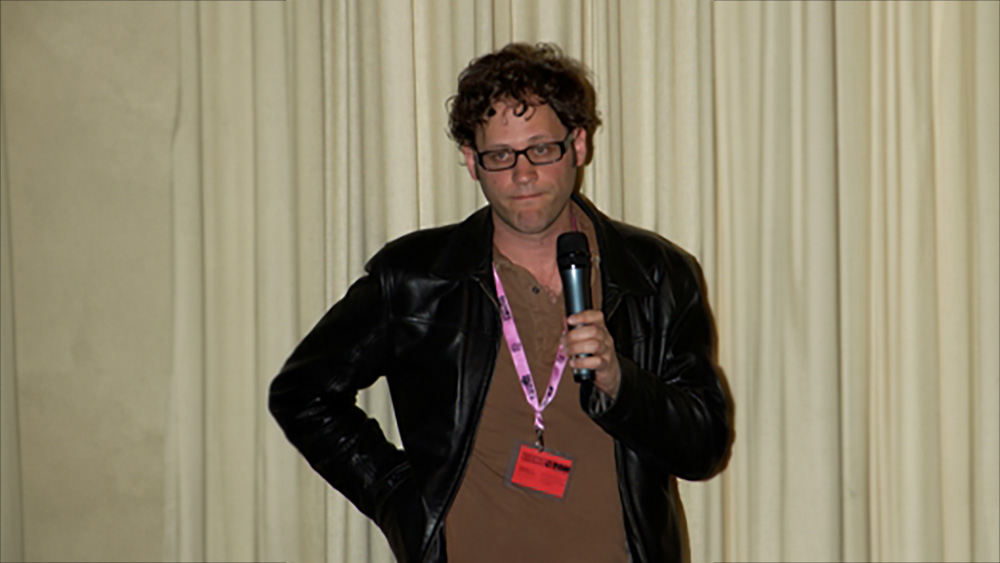
Jamie Kastner präsentierte beim Dok. Fest 2008 in München seinen Film "Kike Like Me". Der kanadische Dokumentarfilm beschäftigt sich mit der Frage, was es bedeutet, in der heutigen Zeit Jude zu sein. Wir haben uns mit dem Regisseur unterhalten.
MC: What was your personal career in becoming a filmmaker?
JK: My career actually started in a combination of print journalism, writing and theater. I had studied theater, literature and drama in university and I had worked for newspapers and I had written and directed plays. I loved theater acutually but it was such an abismo way of trying to make a living, there are terrible prospects. I am very bourgeois and so I thought I’d better find some way that I can make half a living at least and so I got into the world of the the camera, of television first, and then through doing shorter pieces. I produced for different kind of culture and arts shows and some semiinvestigative things although most of my work always had some kind of element of comedy in it. I gradually built up towards doing longer films.
MC: How did you come up with the idea for your movie?
JK: The inspiration for “Kike Like Me” was, as I say in the film, that people have often asked me, are you Jewish? I would have wanted to ask them in return, why do you want to know.
And this really was something that has happened frequently in my life, I am not sure exactly why, maybe because the way I look, because of my name, which ironically is a German name, but in any case it’s a question that kept coming up and made me somehow uncomfortable. It made me want to know, why the person asking the question, was asking the question because it always seemed to carry some potential element of prejudice in it even if it wasn’t threatening whether the question was being asked by a Jew or by a non-Jew, it always seemed to make some assumptions, no matter the answer they had in their mind was, about the individual that didn’t really take into consideration who I might be as a person. Stemming from being asked that question a lot I just thought of how to turn it into a film, basically. […]
MC:Is there anything special you want to tell the people with your movie?
JK: I think what I am trying to do with “Kike Like Me” is start a discussion. I see it as a film about identity, that happens to take Jews as a case study. It raises questions about identitiy that would be appropritate to any non-white, non-mainstream group. But I think what’s interesting about Jews as a case study is that they are white, largely. And yet never, no matter how far into the mainstream Jews you get, you always made aware of the fact that they are Jews. So in America, for instance, it’s always the Jewish Neocons or this Jewish corrupt basketball commisoner. Something about those people subsession with identity issues is interestingly manifest in the case of Jews. I don’t see the film on the last word on anything, on anti-Semitism, on Jewish identiy, on indentity or anything of a sort. I really see it as a starting point of a discussion. And fortunately, so far, it seens to have accomplished that.
MC: The titel “Kike Like Me” is quite provocative. Why did you choose this title?
JK: The title “Kike Like Me” first of all is a reference to an earlier work, which is called “Black Like Me”, which is a book in the late fiftees, I believe, in which a white journalist took skin pigmentation to make his skin dark and went out into the American South as a kind of social experiment to find out what is was like to be black at that time. There is also an book and movie, that preceeded that by a dozent years, called “Gentelmen Agreement”, in which a non-Jewish journalist starts telling people, he is Jewish, to do a story on anti-Semitism. So it was a reference to those works, which I was taking as some kind of model for my concept of this film, basically. Then you could ask the question, why not “Jew Like Me” instead of “Kike Like Me”. I called it “Kike Like Me” because kike is an offensive and old-fashioned word and unfortunately what I discoverd over the course of filming is that the attitutes I found were accurately represented by that title. I mean, one of the essential questions of film for me is whether identity is yours to choose or whether it is something that is more meaningful defined by others and how they perceive you. I went out to make a film to find out what’s liked to be perceived as being Jewish and I found that this old-fashioned insult was an appropriate way to describe that perception unfortunatley.
MC: We have seen the German premier of your film. Did the German audience react differently than the Canadian?
JK: It’s interesting now to have the film premiered in Germany and now to be able to compare it to reactions I have got from different places. All audiences react different to different points in every screening. For one thing, seeing it in Germany for the first time with an audience there was no applause when the film ended. The ending is pretty powerful. And I think people are usually kind of shell shocked in one way or another however they usually applauded in the end. So I was deeply hurt and I thought they were all anti-Semites because they didn’t start applauding immediately. I was aware during the screening of watching myself on screen saying all kinds of aggressive things about German attempts to commemorate the Holocaust and was very conscious of being in a room full of Germans while this is going on and I was looking for the exits just in case. But on the whole, ultimetaley as the Q and A started I kind of forgot that I was in Germany. It was a similar kind of discussion to discussions that have been had after the film all over […].
MC: You are quite critical of Jewdaism? Did you experience any accusing reactions after you showed your film?
JK: I don’t know if you could say I am critical of Judaism. You could call the film an investigation. But it’s superficial. It’s more like I am just a tourist, going around the world trying get a sense what it means to be a Jew or to be perceived as being Jewish. I think I go through it with a genuine openness and I laugh when things that are funny, and I raise an eyebrow when things that are questionable, and I cry when things are upsetting. I am not consciously trying to react one way towards Jews or to non-Jews. If somebody is doing something that I think is strange and he is Jewish, I react the same way as if I think a person is behaving strangly and non-Jewish. But I wouldn’t say I am deeply critical of Jewdaism in the film, that said there has been a lot to the film that has been considered offensive to some Jewish people. I know that lots of people I know have not come and seen the film because of the title and the other section, which is the most controversial for Jews, is the section about Auschwitz. I showed an almost finished cut of the film to some friends in Toronto, who are kind of middle-aged secular Jewish couple and they had completely different reactions, I mean the husband and wife. He totally got the film and got the the point of view in the same way that I intended it and she was quite disturbed by it and told me at the end that she wasn’t sure whether I was an anti-Semite or not because she felt that much of my attitute, my aloofness and my distance are form the subject seemed unfeeling and insensitive and particulary she said how dare I mock something that she condiders sacred in Auschwitz. Of course after I got over the initial shock of being called an anti-Semite by someone who knows me as a friend. I thought thinking of their two reactions, this is working. I wanted to provoke discussion. There have been done lots of work and films on anti-Semitism by Jews and obvisiouly friendly towards Jews. I didn’t want to make an Jewish film, not that I am revealing if I am Jewish or not incidettally, but let’s say I were, I didn’t want to make a film that said, well, I am a nice Jewish boy and look at all the mean things that have been done to us. Who would care, Jews know all this already and non-Jews wouldn’t pay any attention. That’s just a Jewish thing. I wanted to make something that would try to provoke a wider audience into considering this issues and considering it in the larger context of identity.
MC: You shot in different countries. On which anspects did you chose your locations on?
JK: I ultimately chose where I shot based on where I might get a range of different material. Obviously when you make a road movie you want to have each stop on the journey reveal something different on the story. […]I chose things in different countries that were unexspected combinations of shades of my topic and then I assembled them in a way that there would be some narrative progression from one to the other so that you felt that you were learning something new at every step at the journey.
MC: How reliable are documentaries from your point of view? Do they really tell the truth? What are they for?
JK: This is a huge question and it’s question that obviously comes up a lot on documentary festivals and in general nower days and Michael Moore has taken certain amount of heat for not being accurate or not being truthful enough. As far as I know from the dawn of documentary, which I understand goes back to Robert Flaherty and “Nanuk of the North”, they were already setting up shots, they were already getting Eskimos, as they were still called then, to stand in such a way and get in their canoes in such a way. It’s always been a form just like filmmaking or writing or whatever that always has a certain amount of subjectivity to it. It’s the team of authors perception of what is truth that is being presented. It’s interesting coming to Germany as a North American who has done a film on Jewishness. And it’s always a little discomforting frankly. When you fly in the plane and you think about what you know about the war and what you know about history and what you know about this country and you think of it in terms of the films and books you’ve read because I have grown up in another part of the world and it make one aware of the extend to which in all of this works of art or education, you always only getting a slice of the picture. I mean life is so overwhelming and vast and the 360 degrees of experience of being alive and all the contradictory emotions and what you feel and and what everyone else feels and that crazy idea of life and humantiy where every little person thinks that he or she is a universe and they have their own version of this going on. I mean it’s so as if somebody has said, I mean, you could write a novel every second based on what’s going on in any given room, in any walk down the street. When you think of the novels that are actually written or the documentary films that are actually made, you only get a slice. And somebody is choosing what that slice is. And hopefully they are choosing it from sincere motivation to try to present the truth as they see it. Hopefully you can apply some kind of standarts of discrimination and journalism unbalanced or you understand the context in which they are speaking is a polemic like Michale Moore or an essay film like mine. You try to see if there is a consistancy to that. Are they kind of staying true what they set out to do.
MC: Are there any advices you can give to joung filmmakers who want to make their first documentary?
JK: Go to to law school. Forget it. Do something secure. Get a nice job. Learn plumbing that’s a very good trade. Some electrical engineers were in my audience last night and stuck around for a beer and I told them the same. I said, my mother would be very happy if they stayed with electrical engineering. Get a fall back profession first then you can make a film as long as you have an electrial engineering to fall back on.
Any advice for young filmmakers? I think the advice for young filmmakers would be the same as for any practitioners of the arts, try to get as a broad an educations and as much an experience as you can. I think there is a big emphasis on the freedom of cheap equipment and how anybody can make a film. You know, technically that’s true. But you still want to become an educated, broad-minded person, and learn about all sorts of types of story teeling, and all kinds of thought, and read a lot, go to a lot of galleries, don’t just sit at home learning Final Cut.
MC: Are there any skills that would be essential for a young director?
JK: I expose, I work within some kind of tradition of narrative filmmaking, so the ability to tell a story would be useful, would be a useful skill for a young director. It’s a question mark. I didn’t go to filmschool. I’ve always favoured learnig by experiece. And I think filmschools are a relatively recent invention, sometimes now I fantasize going to filmschool, having it done for a number of years I think, would’t it be interesting to sit around talk about this and learn how a camera actually works and fill in the little gaps. But I am not sure if I have time to do that right now, unfortunately. It can only be good to learn how to shoot, learn how to edit. Then you are holding the paint brush, that can only be great. However, I’ve always valued I’ve come up in a time where it was a little bit of the old and a little bit of the new. I mean, you know I was working at CBC, which is the Canadian public broadcast and on places like that, where there were trained cameramans and trained editors and they were all carefully protected by unions and so you couldn’t just sit down on a editing thing anyway but I grew to understand and respect the craft of this people who have been doing it for thrity years and I was never gonna be able to make a shot as go good as they were, just like that anyway. I think there is a lot to think about when you are out on a shot and it’s taken me time and mistakes to learn how to plan more. On the one hand I think planning is great, the more you plan the better off you are. On the other hand you have to constanly ready to improvise. Go and try to keep you intuition and your instinct alive to just follow something that is good. […]
MC: Thank you for the interview.